
If you're trying to show up in ChatGPT, Google's AI Overviews, Claude or Perplexity, you don't need another AEO checklist.
I've watched people stand on stage at big SEO conferences and recommend putting keywords in the URL, adding FAQs, writing clear paragraphs and creating pages that target keywords. All presented as brand-new answer engine optimization tactics.
They're not new. I've worked in SEO for more than 10 years, and most of what helps brands show up in AI answers is what good SEOs have been doing all along.
That doesn't mean nothing has changed. Some things have, and I'll get to them. But I don't think the answer is to throw away what we know about search and start again. The better approach is to get the SEO basics right, then understand what sits on top of them.
Below are seven tactics I'm using with companies right now to improve their visibility in traditional search and AI search. The video walks through more examples if you'd rather watch.
1. Build proper category and solution pages
This is the most basic tactic on the list, and big brands still get it wrong.
If you sell more than one product or service, you already group them somehow. On Shopify they're called collections. Most e-commerce sites have categories and subcategories, and many go further with filters. On Wayfair you can filter by colour, frame colour, tone, price, size and dozens of other attributes. Shoe retailers do the same with size, sport, gender and material.
The idea is simple. Instead of one huge page with everything on it, you create useful pages for the groups of products people actually search for.
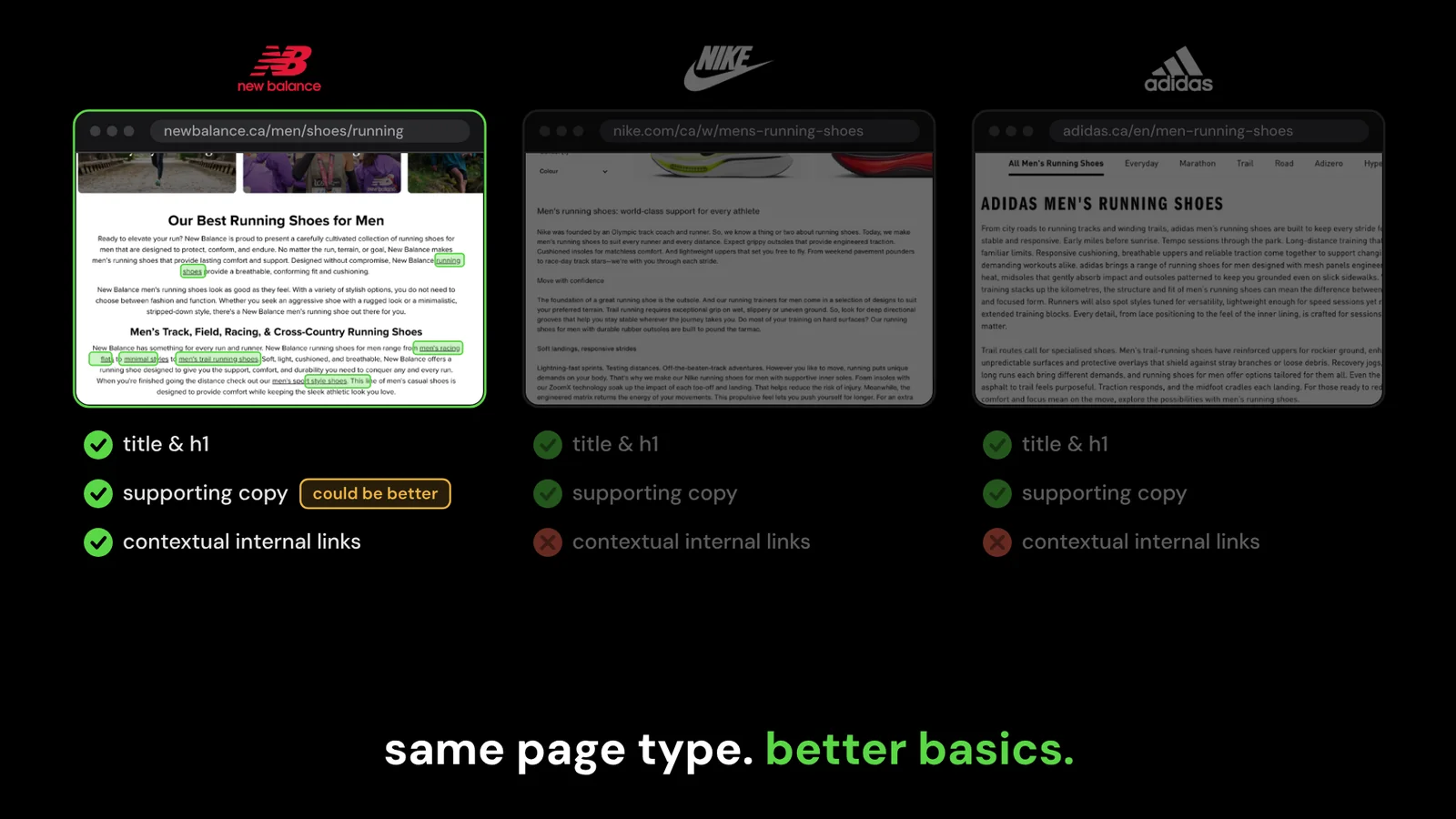
I recently compared the men's running shoe pages from New Balance, Nike and Adidas. All three have category pages, but New Balance did the basics better:
- a relevant title and H1
- supporting copy about choosing and caring for running shoes
- contextual internal links to related categories
Was their copy amazing? No. I think it could be better. But in the Canadian results, New Balance was outranking Nike and Adidas in both regular search and AI search. There was no secret AEO tactic involved. It was SEO 101.
The same applies to service businesses. Say you're an HVAC and plumbing company. Don't have one “Services” page with plumbing, heating and air conditioning listed underneath. Build a plumbing section with dedicated pages for hot water heaters, pipes and other services, then heating and cooling, drainage and commercial sections.
Before you worry about AEO, ask yourself: does every important product or service you sell have a useful page that says what it is, who it's for and what it does?
2. Create pages for the industries, audiences and use cases you serve
This one is getting more attention because AI answers can be personalised. The recommendation I get might be different from yours, depending on our past conversations, location, job, company size or what we've told the AI.
Again, the tactic isn't new. B2B software companies have built pages like email marketing software for e-commerce or workforce planning software for manufacturing for years.
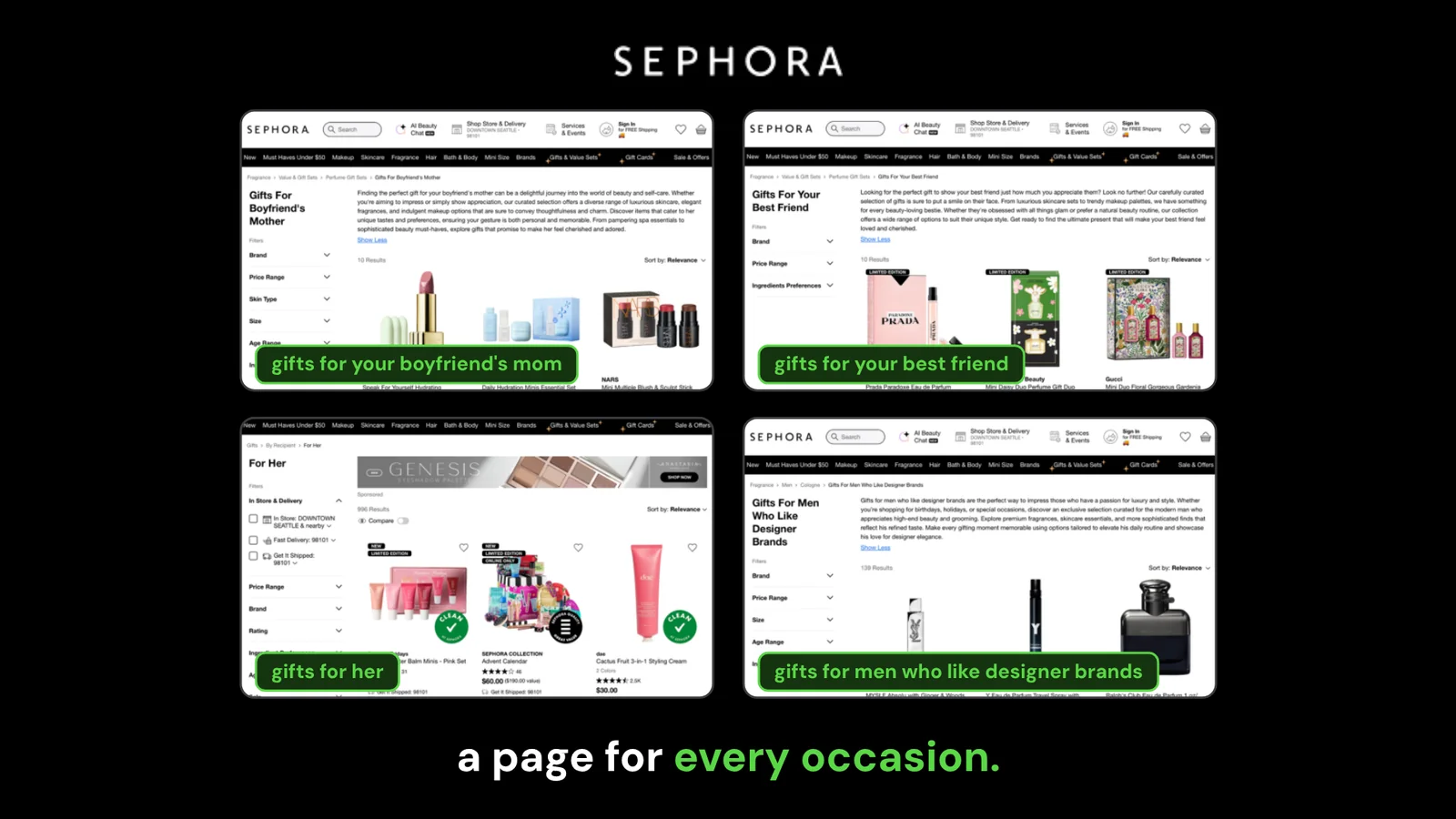
And you don't need to sell enterprise software to do it. Sephora has pages for very specific occasions and audiences: gifts for your boyfriend's mom, gifts for friends, gifts for her, gifts for men who like designer clothes.
It works because people don't always search for a product. They search around their situation. That matters even more in AI search, where prompts are naturally more descriptive. Nobody asks ChatGPT for “perfume”. They ask, “What should I buy my boyfriend's mom for Christmas for under $50?”
A big caveat: don't take this as permission to generate 10,000 thin pages with AI. We've seen companies go overboard with programmatic SEO before. Some of it works for a while, then creates much bigger problems.
Focus on meaningful segments. If you genuinely serve four industries, create four excellent industry pages. You don't need 400 pages with the industry name swapped out.
3. Inspect the query fan-out before you create anything
This is where AI search really is different.
When you ask ChatGPT or another AI tool a question, it often runs several searches in the background before answering. That's the query fan-out.
Ask “What's the best coffee maker for a small apartment?” and the AI might search for:
- compact coffee makers for small kitchens
- single-serve vs drip coffee makers
- espresso machines for small counter spaces
- coffee maker reviews
- easy-to-clean and quieter machines
- price comparisons
This is where a lot of AEO advice goes wrong. People see that the AI ran seven searches and decide to make seven new pages. That's not the move.
What I want to know is what the AI finds when it runs those searches. Which websites appear? Which sources does it trust? Which brands keep coming up?
Say you're a coffee maker brand and you're not being recommended. You inspect the fan-out and find the AI keeps using three big coffee review sites to compare products. Your biggest opportunity probably isn't another article on your own site. It's getting your product legitimately reviewed on those three sites.
I've seen the same in B2B. For financial software queries I've worked on, the fan-out included searches around Gartner, G2 and Capterra. If Gartner keeps appearing in the searches that matter and our Gartner presence is weak, that's what I work on.
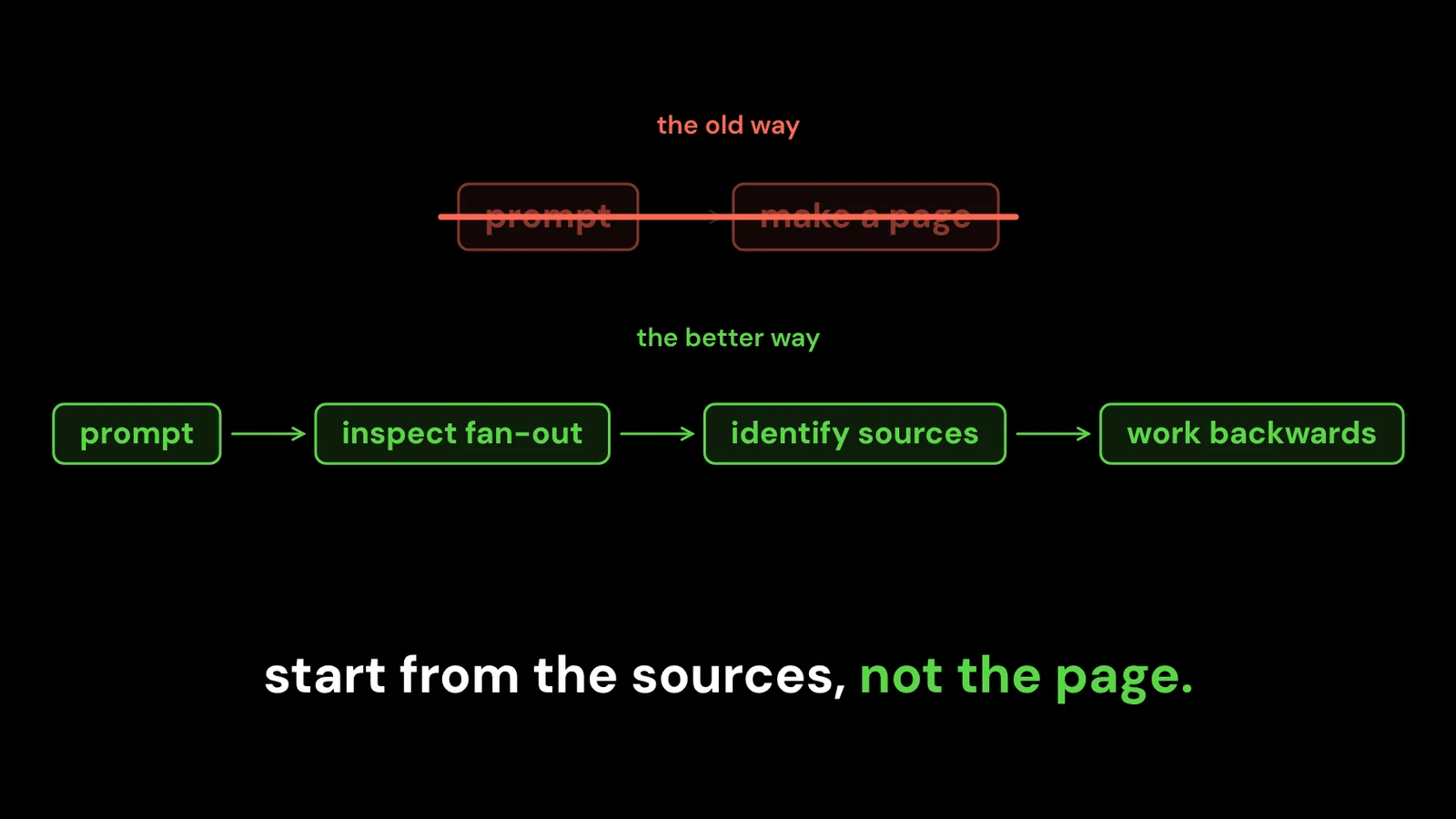
So instead of prompt → make a page, think:
prompt → inspect the fan-out → find the sources it trusts → work backwards
4. Tell the same brand story everywhere
AI tools don't learn about your company from your homepage alone. They pull from your site, third-party sites, reviews, press coverage and anything else they can access. So the story about your brand needs to be reasonably consistent.
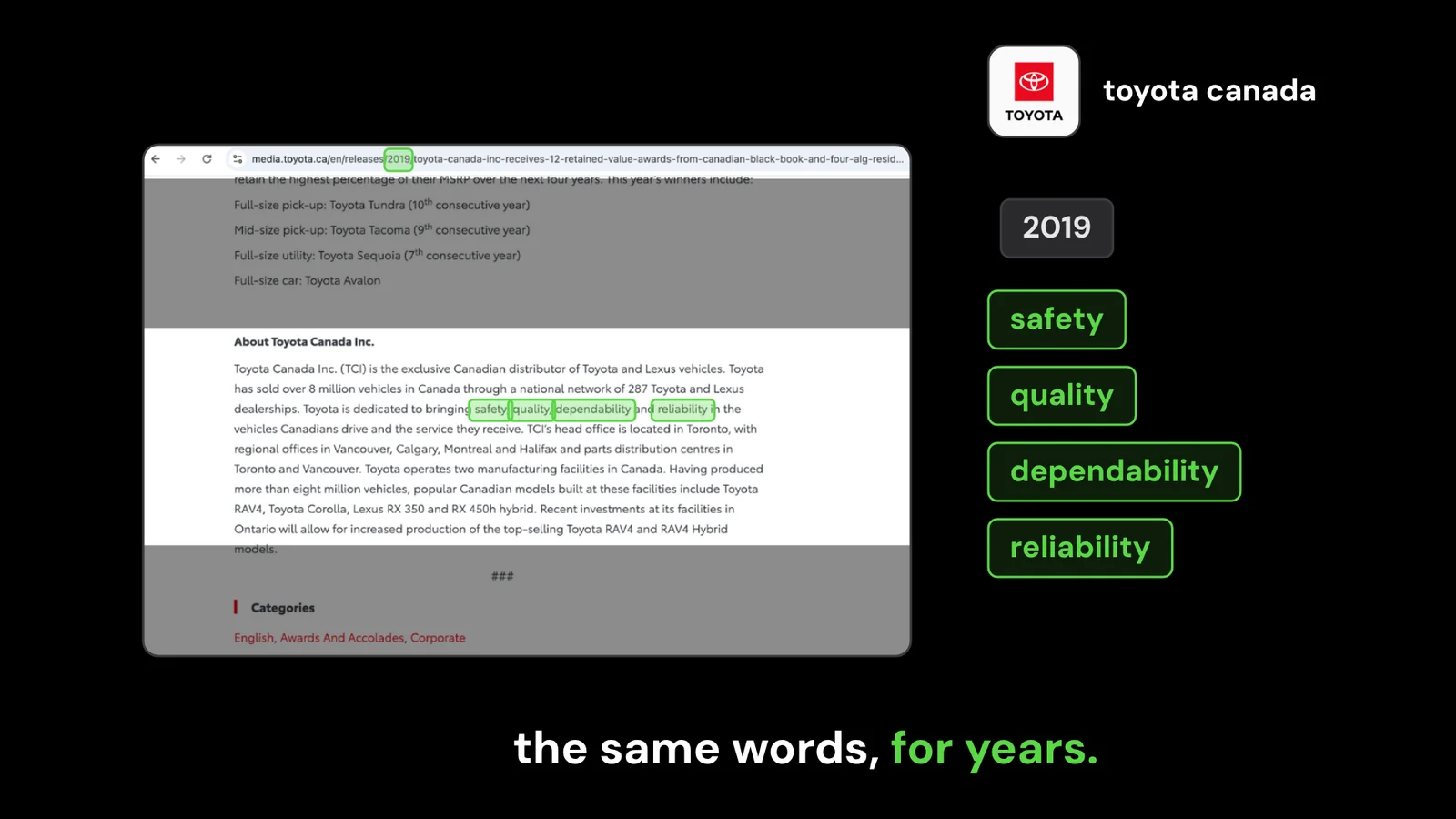
Toyota is the simple example. It's been associated with reliability for decades. Its own website and press releases have used that language for years, and publishers, reviewers and customers repeat it. The web has reached a consensus that Toyota means reliable, and that now shows up in AI answers too.
But there's a catch. You can't decide tomorrow that you're the world's most reliable car company, put out 100 press releases and expect everyone to believe it. The product and customer experience have to back up the positioning.
In B2B, the problem usually looks like this. Your homepage says enterprise platform. Your G2 page says mid-market tool. Old articles talk about small businesses. Capterra positions you differently again, and your LinkedIn says something else. The AI now has conflicting evidence.
If you're moving from mid-market to enterprise, changing the homepage isn't enough. You might have 10 years of content and third-party evidence tying you to mid-market, and that takes time to shift.
Audit the places your company is described:
- your About and product pages
- G2, Gartner and Capterra
- partner pages
- press coverage and other prominent third-party sources
They don't need identical copy. They should roughly tell the same story about who you are, who you're for and what you want to be known for.
5. Publish comparison content, but make it credible
Comparison content is often presented as a new AEO tactic. It isn't. Pages like brand A vs brand B, competitor alternatives and best software round-ups have been around for years in SEO and paid search, because they reach people close to a decision.
What's changed is that AI tools can now use those pages when someone asks a direct comparison question. If someone asks ChatGPT “Should I choose brand A or brand B?” and you have nothing explaining how you compare, the AI builds that comparison entirely from other people's information.
So your side of the story should exist somewhere search engines and AI tools can find it.
But we're also seeing the limits. Some industries have gone overboard with self-serving listicles: a new company publishes “10 best tools” and conveniently ranks itself first. The problem is that AI tools don't rely on one source. In my own testing, I've seen ChatGPT run site-specific searches on real third-party review platforms instead of trusting vendor listicles. I've also seen Claude flag when recommendations look heavily influenced by promotional content.
And there's a bigger issue. You can publish a “best software” article, earn the citation, and still not get the recommendation. The AI can read your article, combine it with five other sources and decide an incumbent deserves the top spot.
Make comparison content useful and credible. Explain the real differences between you and your competitors. Don't publish 200 fake “best” articles and assume that because you're getting cited, you're winning.
6. Stop treating citations as the goal
This is the most important point in this post.
Video and social content have been called a cheat code for AI search, because they can show up in AI answers. And they can. But look at what happens when they do.
I looked at Google's AI Overview for best email marketing software. It cited YouTube videos alongside review sites and publishers. In one cited video, the creator ranked Brevo as their number one email platform. But the AI Overview didn't repeat that. It presented MailerLite as the best overall option. The same video was cited again for another category, where Sender was surfaced as the budget pick. Brevo, the creator's number one, appeared further down under value and multi-channel features.
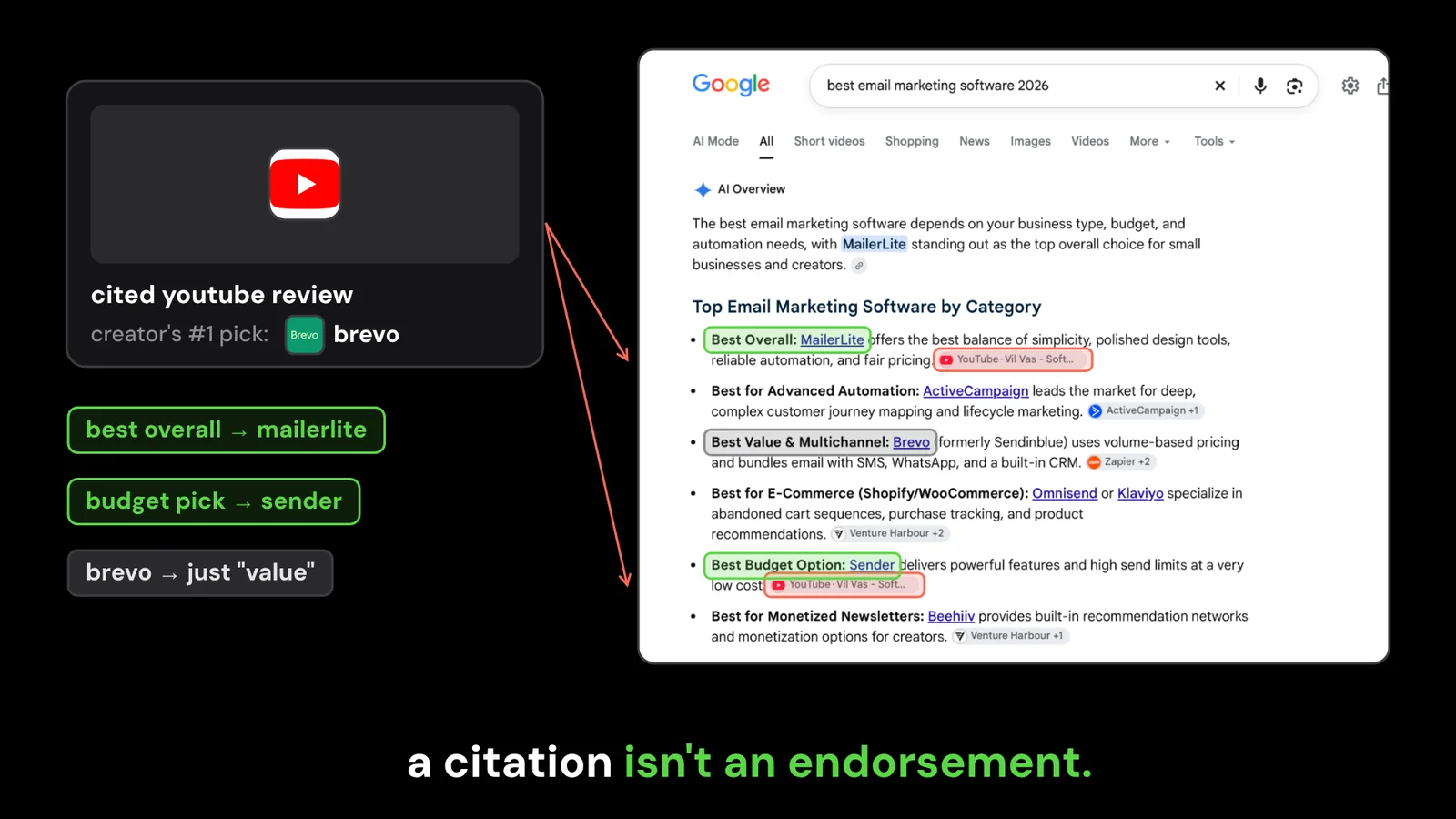
A citation does not mean the AI accepted what the source said. It can take one fact from your content and use other sources to form the actual recommendation.
If you measure success by citation count, you can make some very bad decisions. In that same answer, the software companies themselves owned only a small share of the citations. Most came from reviewers, publishers and creators. Does that mean those companies' AEO failed? No. If they're being recommended, they're benefiting from sources they don't own.
We're moving further into a zero-click world, so I care much more about mentions and recommendations than citation counts (more on that in AI citations vs recommendations). The questions I'd ask instead:
- Is AI mentioning your brand when it matters?
- What category does it put you in?
- What strengths does it associate with you?
- What weaknesses does it keep repeating?
- Are people discovering you this way and considering you when they're ready to buy?
7. Ask “how did you hear about us?”
Attribution is messy. Someone might discover you in ChatGPT, research you on Google, watch a YouTube video, read Reddit, and come back through a branded search a week later. Your analytics will credit the branded search.
One of the simplest fixes is to add a “How did you hear about us?” field to your forms and include AI / ChatGPT as an option.
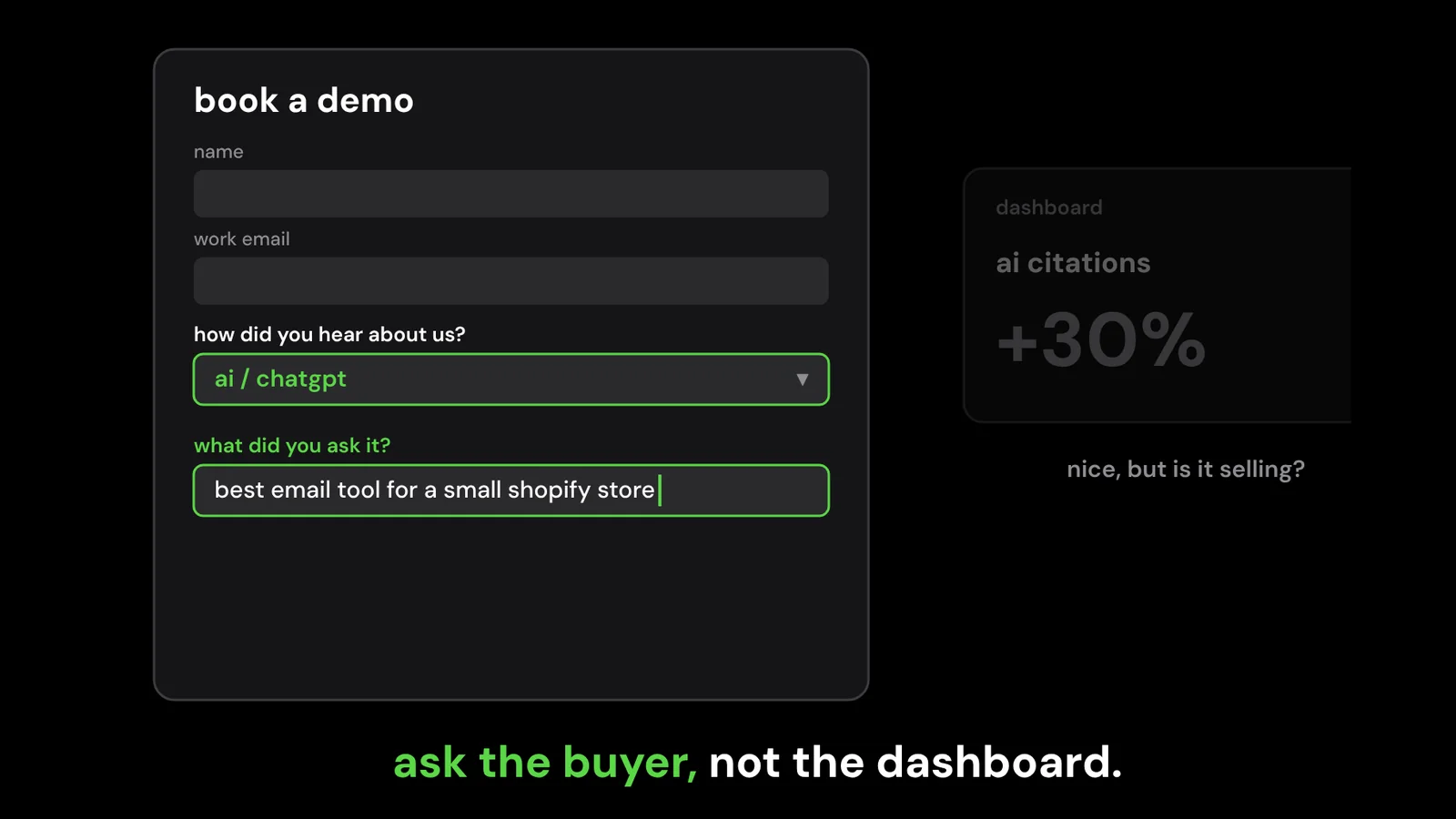
If you want to go one step further, ask the people who choose it what they actually asked. That tells you far more about whether your AI search strategy is working than celebrating a 30% jump in citations.
What's actually changed, and what hasn't
AI search is changing things, just not as dramatically as the acronyms suggest.
What's new or matters more:
- query fan-out
- personalisation
- third-party sources
- AI building its own interpretation of your brand from multiple places
- the need for better ways to measure AI's influence on the customer journey
What hasn't changed: the foundation. Clear category pages, useful audience pages, a consistent brand, credible comparisons and real customer insight have always been good SEO.
What I'd do this week
- Check your top category or service pages. Does each one say what it is, who it's for and what it does, with a proper title, H1, supporting copy and internal links?
- List the industries, audiences or use cases you genuinely serve, and check each meaningful one has a useful page.
- Pick three prompts that matter to your business and look at what the AI searches for and which sources it uses.
- Audit how your brand is described on your site, LinkedIn and your main review platforms.
- Make sure your side of the story exists for your most common “A vs B” comparisons.
- Track how AI describes and recommends you, not just how often you're cited.
- Add “AI / ChatGPT” to your “How did you hear about us?” field.
Give buyers a reason to shortlist you
After more than 10 years in SEO, I still start with the same question: what would a buyer need to see before putting this company on their shortlist? The answer might be a clear service page, a comparison that explains the trade-offs or an independent review from someone who's used the product.
AI search makes it easier to see how those pieces come together. If an answer recommends a competitor, look at the reason it gives. That reason can tell you what buyers value and where you have more work to do.