
Improving salience scores for sentences on your website can help you boost your leads and revenue. Here's exactly how to do it.
What Is Natural Language Processing?
Before we talk about salience, let's briefly cover NLP.
According to Google: "Natural language processing (NLP) uses machine learning to reveal the structure and meaning of text. With natural language processing applications, organizations can analyze text and extract information about people, places, and events to better understand social media sentiment and customer conversations."
In simple terms, Google uses Natural Language Processing when working out where to rank your page in the search results. The concept of salience falls under NLP.
What Is Salience?
According to Google: "The salience score for an entity provides information about the importance or centrality of that entity to the entire document text. Scores closer to 0 are less salient, while scores closer to 1.0 are highly salient."
Google is essentially telling you that content with higher salience scores will be favored in the search results. But how is that possible, and how can you measure it?
How Can You Measure Salience?
You can measure your salience score with Google's Natural Language API demo. Enter the specific text you want analyzed. To begin with, I'd recommend analyzing the first sentence or two for every paragraph in your article, followed by all sentences that use your main keyword.
Let's test it out.
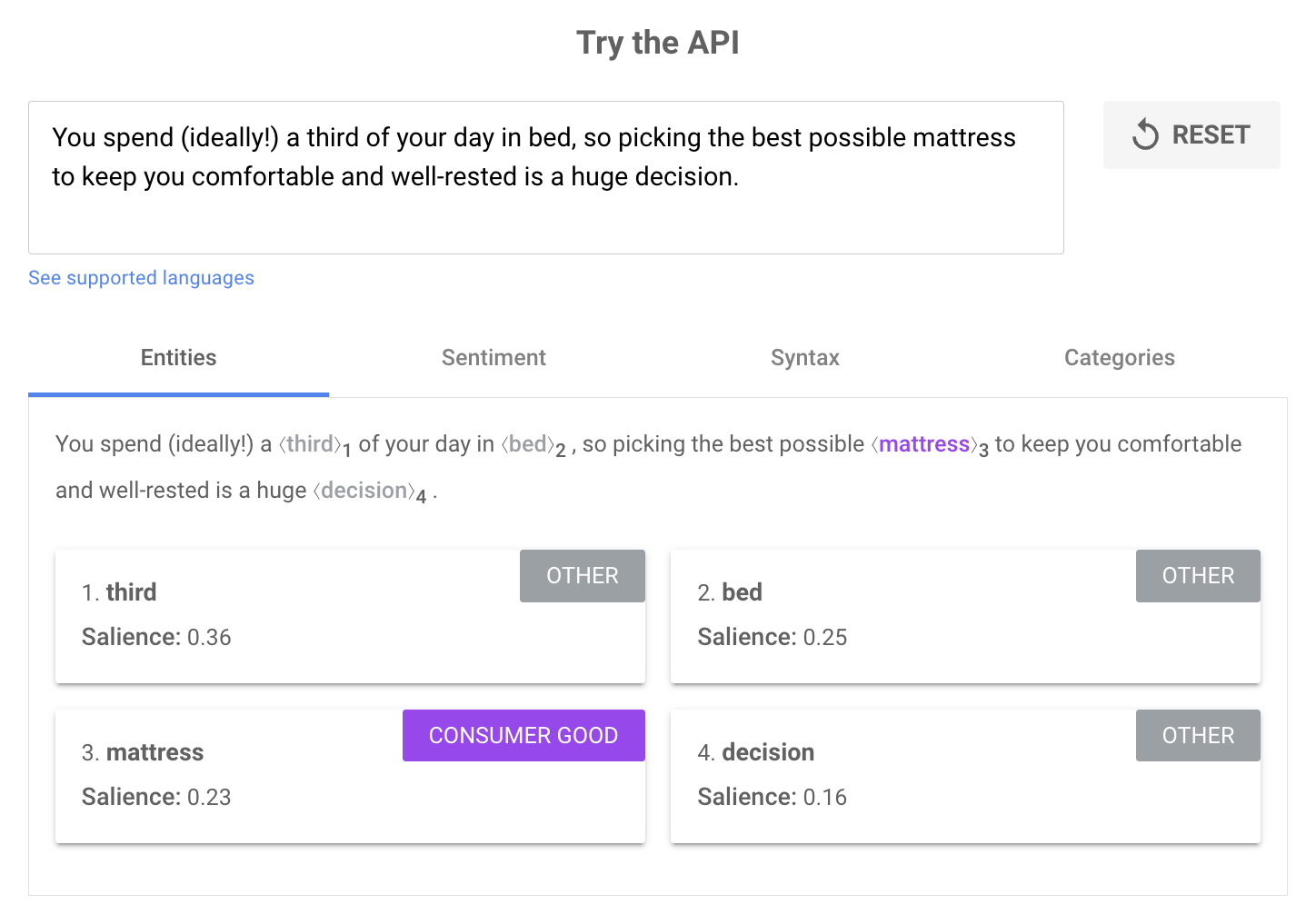
So what do the numbers and colours mean?
Under the entities tab, you'll find where your main keyword (or part of it) is listed. If your keyword isn't the most salient entry, there's room for improvement.
The colours represent what category the keywords fall under. In this case, "mattress" is identified as a consumer good. It's really important that your most salient keyword is identified as the category it belongs to. If you're reviewing a mattress, Google needs to classify it as a consumer good.
Here the API correctly identifies a mattress as a consumer good, but the most salient entry is "third." Our goal is to make "mattress" the most salient entry.
How Can You Improve Salience Scores?
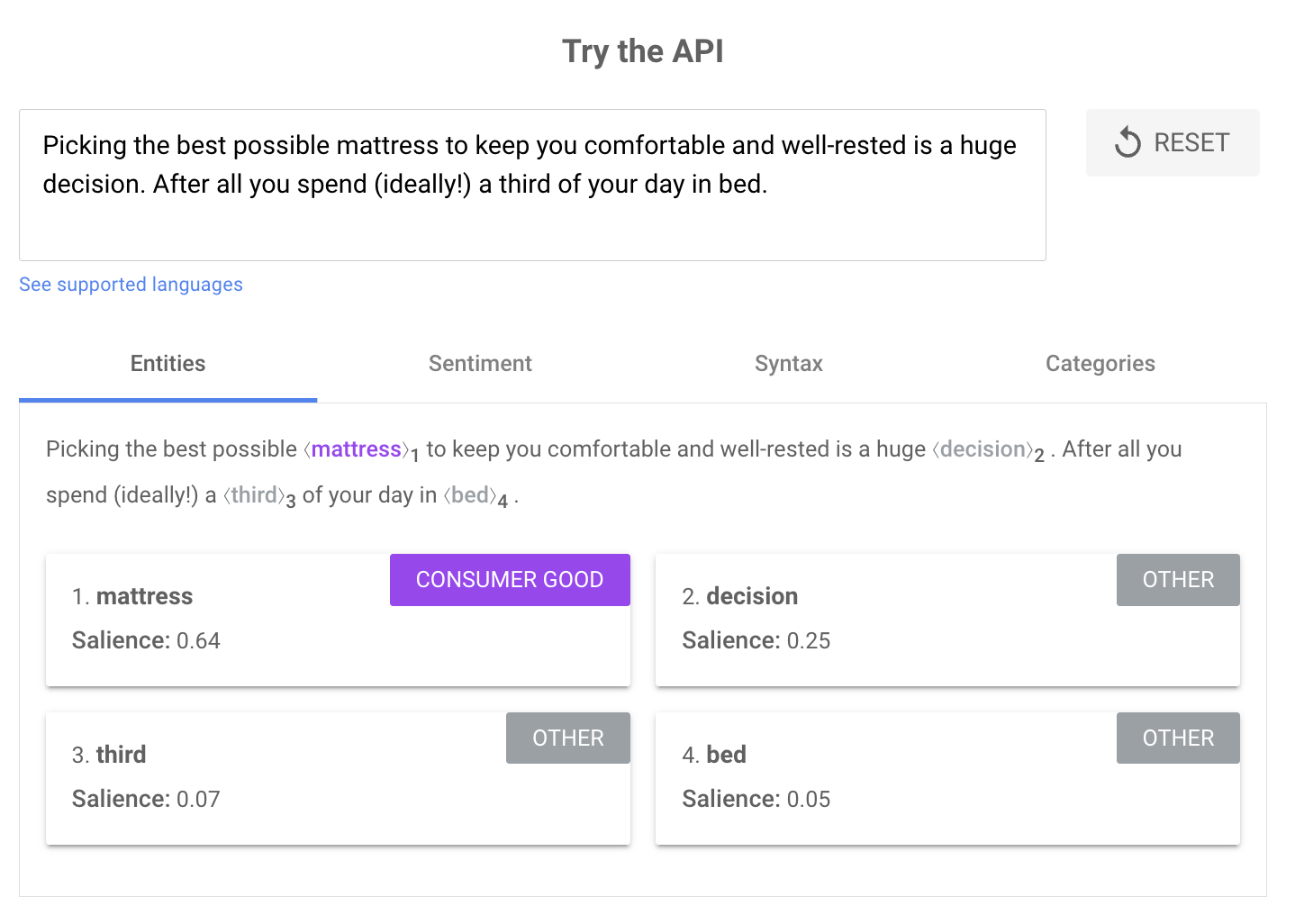
Without using AI, you can try rearranging the order of your keyword in the sentence. Sometimes moving the main keyword closer to the front helps. Your sentence still needs to read naturally, of course.
It worked. After rearranging the sentence, the salience score for "mattress" nearly tripled.
There's another way to improve salience, and that's by using AI with this prompt:
💡 Prompt: Can you help me improve the salience score for the keyword [your keyword] of the following sentence: [paste your sentence]
Over time you won't need to rely on Google's tool. You'll naturally be able to sense whether the salience of your sentences makes sense for the keywords you're trying to rank for.
Salience Is One Part of a Wider SEO Strategy
Improving your salience score alone will not move your rankings. You still need all your other SEO elements to be in order. Think of salience optimization as one lever among many.
Improving your salience score on a noindexed URL won't help you rank. So while you're here, why not take a look at my guide to completing a full SEO audit?